
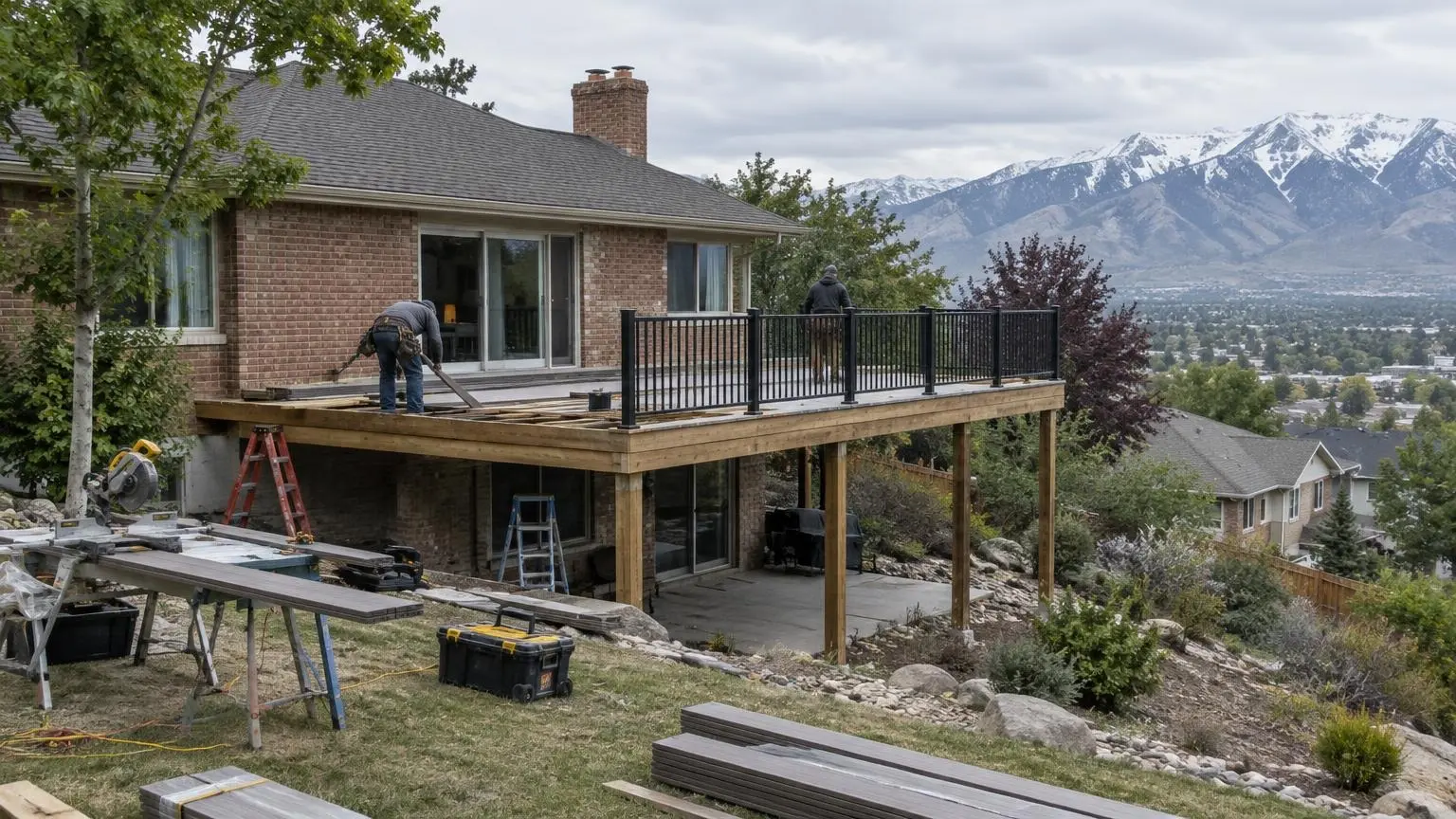
Elevation 4,820 feet, at the mouths of two canyons
Deck Builders in Cottonwood Heights, UT
Raised decks, walkout levels and stairs for hillside homes on the ridge between Big and Little Cottonwood creeks.
- Free on-site estimates
- Written, itemized quote before work starts
- Footings planned for Salt Lake City's 30-inch frost depth
Decks Built for the High Side of the Valley
Deck Builders in Cottonwood Heights face different conditions than builders on the valley floor. The city sits at about 4,820 feet, roughly 500 feet higher than central Salt Lake City. A high ridge separates the Big and Little Cottonwood Creek valleys, which narrow into Big and Little Cottonwood Canyons at the city's east edge, and suburban housing covers that ridge. Sloped lots, more precipitation and heavier snow all come with the views.
Higher elevation, heavier snow
Salt Lake City applies a minimum 28 psf ground snow load only at or below 4,239 feet. Above that, it points builders to the Utah Snow Load Study. Cottonwood Heights sits well above that line. The study's map, maintained by Utah State University, uses elevation as its main predictor of ground snow load, so higher sites generally carry heavier design loads. We confirm the exact value Cottonwood Heights requires for your address and size the joists, beams and any cover to match. A deck designed for the valley floor may not be enough here.
More water from the sky
Average annual precipitation in Cottonwood Heights is about 25.92 inches based on 1991 to 2020 data, with December, January and February each around 2.3 to 2.4 inches. Salt Lake City's airport averages about 15.52 inches a year. More moisture means wood stays wet longer and snow sits on the deck through more of the winter. We like composite boards here, metal railings and framing details that shed water, such as joist tape and spaced ledger flashing.
Sloped lots and walkout decks
Homes on the ridge often have walkout basements, a main floor well above the back yard or a yard that drops steeply away. That calls for taller posts, diagonal bracing, longer stair runs and sometimes two levels: an upper deck off the kitchen and a lower patio deck off the basement. We measure the slope during the estimate and draw the stairs before we price anything, because stairs on a hillside can be a large share of the cost.
- Raised decks with braced posts on sloped yards
- Two-level decks connecting main floor and walkout basement
- Composite decking for wetter, snowier conditions
- Railings and stairs built for long runs down a slope
- Snow-rated covered decks and pergolas
- Staining and sealing for cedar and pressure-treated wood
A newer city with settled owners
Cottonwood Heights was a census-designated place until it incorporated on January 14, 2005, after a 2004 referendum. Census estimates show 72.4% of homes are owner-occupied, 88.5% of residents lived in the same house a year earlier, and the median owner-occupied value is $694,100. Owners here often want decks that hold up for the long haul, and permits go through the city's own building staff, which we confirm for each project.
Getting here from the city
Cottonwood Heights lies along Interstate 215 on its northern border, with State Routes 190 and 210 leading to the canyons on its eastern edge. The drive from our Salt Lake City base is straightforward. Call (385) 506-4516 for a free, written estimate that includes slope, footings, stairs and snow-load design.
Cottonwood Heights Conditions
- High elevation. Cottonwood Heights sits at about 4,820 feet, well above the 4,239-foot line where Salt Lake City stops using a flat 28 psf minimum ground snow load and refers builders to the Utah Snow Load Study.
- Snow load tied to elevation. The Utah Ground Snow Load Map, maintained by Utah State University, gives 50-year ground snow load estimates using a weighted linear regression model that relies on elevation to calculate load at a local level.
- Wetter than the valley floor. Average annual precipitation in Cottonwood Heights is about 25.92 inches (1991-2020), compared with about 15.52 inches a year at the Salt Lake City airport.
- Ridge and canyon terrain. A high ridge separates the Big and Little Cottonwood Creek valleys, which narrow into Big and Little Cottonwood Canyons at the city's eastern edge; suburban housing covers the ridge.
- Mostly owner-occupied. About 72.4% of Cottonwood Heights homes are owner-occupied, the median owner-occupied value is $694,100, and 88.5% of residents lived in the same house a year earlier (Census ACS 2020-2024).
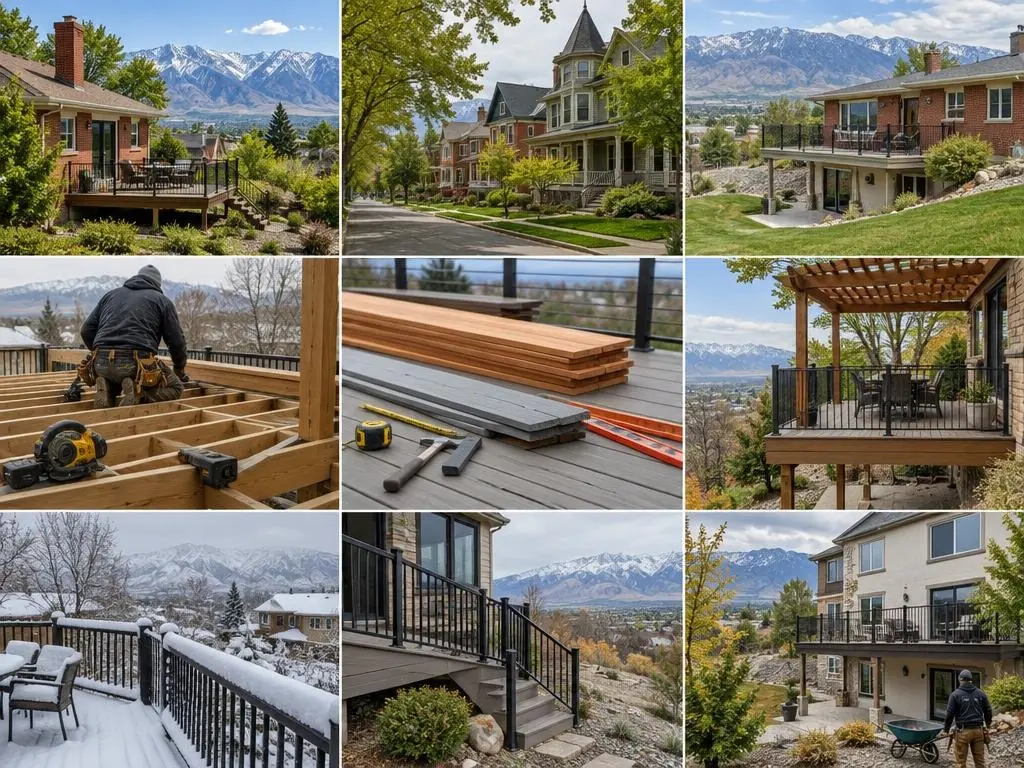
Our Services in Cottonwood Heights, UT
Cottonwood Heights Questions
Does a deck in Cottonwood Heights need heavier framing than one in Salt Lake City?
Often, yes. Cottonwood Heights sits around 4,820 feet, and the Utah Snow Load Study ties ground snow load mainly to elevation. We confirm the required load for your address with the city and frame to it, which can mean larger joists, closer spacing or bigger beams.
My back yard drops off steeply. Can you still build a deck?
Yes. Steep lots need taller braced posts and longer stair runs, and sometimes a two-level design works better than one tall deck. We measure the grade during the estimate and show you the options.
Is composite worth it this close to the canyons?
With about 25.92 inches of precipitation a year, wood here stays wet longer than on the valley floor. Composite resists moisture and needs less upkeep, though wood is still an option if you are willing to seal it regularly.
Can I add a roof over my deck at this elevation?
Yes, but the cover has to be designed for the local snow load, which is likely higher than in the valley. We size posts, beams and rafters to the confirmed load before quoting a cover.
Free Estimates in Cottonwood Heights, UT
Free deck estimates in Cottonwood Heights.
Deck Builders Near Cottonwood Heights
- Deck Builders in Salt Lake City, UT
- Deck Builders in South Salt Lake, UT
- Deck Builders in Millcreek, UT
- Deck Builders in Holladay, UT
- Deck Builders in Murray, UT
- Deck Builders in Sandy, UT
- Deck Builders in Draper, UT
- Deck Builders in West Jordan, UT
- Deck Builders in South Jordan, UT
- Deck Builders in Riverton, UT
- Deck Builders in Herriman, UT
- Deck Builders in West Valley City, UT
- Deck Builders in Taylorsville, UT
- Deck Builders in Kearns, UT
- Deck Builders in Magna, UT
- Deck Builders in Midvale, UT
- Deck Builders in Bountiful, UT
- Deck Builders in Farmington, UT
- Deck Builders in Centerville, UT
- Deck Builders in Layton, UT
- Deck Builders in Park City, UT
- Deck Builders in Lehi, UT
- Deck Builders in Alpine, UT