
Once called Mountainville, at 5,049 feet
Deck Builders in Alpine, UT
Elevated decks for hillside lots facing the Wasatch, planned around snow, wildfire history and the fault line under the west side of town.
- Free on-site estimates
- Written, itemized quote before work starts
- Footings planned for Salt Lake City's 30-inch frost depth
Built for the View, Built for the Slope
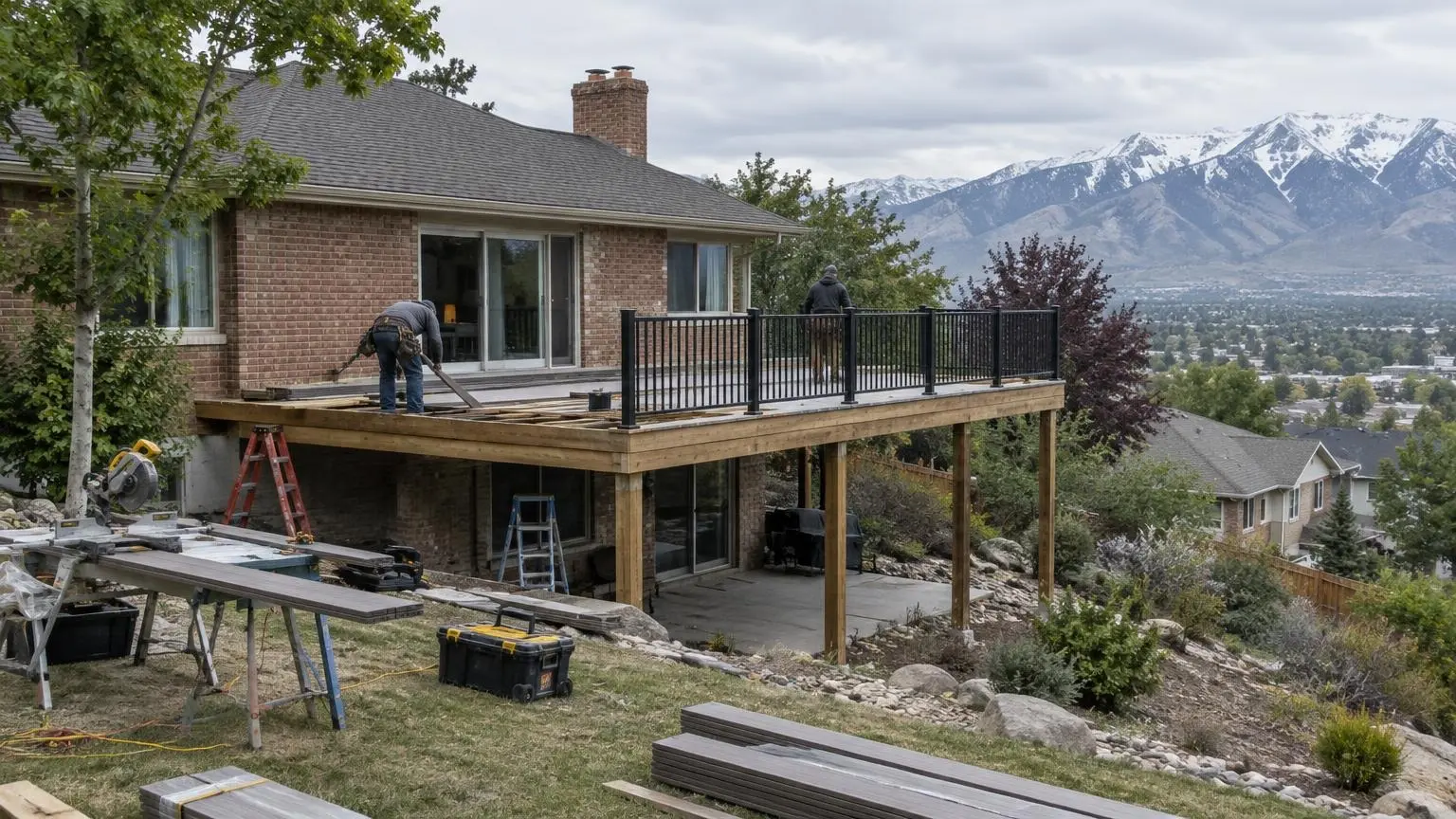
Alpine took its name because early settlers compared the views to the Swiss Alps, and deck builders in Alpine, UT are usually hired to take advantage of that same view. The city sits at 5,049 feet on the slopes of the Wasatch Range at the northeast edge of Utah County. Many lots slope, and the best seat in the house is often a deck hanging off the back, well above the yard.
Three things we plan for here
1. Height and slope
An elevated deck on a hillside needs tall posts, diagonal bracing, footings set into stable soil and a ledger that is properly flashed and bolted to the house. We design the frame for the full height on the downhill side and lay out stairs so they follow the grade instead of dropping straight down.
2. Snow at 5,000 feet
Alpine averages 74.4 inches of snow a year, more than many valley cities, and January highs average under 39 degrees. Snow load and frost depth from the city's building criteria set the size of every footing, beam and joist. We confirm those figures with Alpine's building office before drawing a plan, especially for covered decks and pergolas that catch snow.
3. Fire and fault
The Quail Fire burned more than 2,200 acres on the northeast side of town in July 2012, and the surrounding hills have had other brush fires since. A deck is a place where embers can collect, so we talk through options: keeping the space under the deck enclosed or clear of debris, using metal railings, and choosing board materials with fire performance in mind. The west side of Alpine also runs above the Wasatch Fault, so we pay close attention to lateral bracing and to how the deck ties into the house.
Homes owners keep
Alpine homes are typically owner-occupied, long-held and valuable: 88.8% are owner-occupied, 91.4% of residents lived in the same house a year earlier, and the median owner-occupied value is $977,500. That usually means owners care about materials that last and look right with the house. Materials that fit that goal include capped composite or hardwood decking, black aluminum or cable railings that do not block the view, and stone-clad stair bases.
Our work in Alpine
- Hillside composite and hardwood decks
- Wood decks in cedar for owners who prefer natural boards
- Covered decks and pergolas framed for mountain snow
- Cable, glass-panel and metal railings for unobstructed views
- Deck repair, replacement, staining and sealing
Getting started
Alpine is about 32 miles southeast of Salt Lake City, and it is within our service area. Call (385) 506-4516 to set up a visit. We walk the slope with you, talk through materials, and send a written quote with drawings.
Alpine Facts That Affect Your Deck
- Mountain-slope elevation. Alpine sits at 5,049 feet on the slopes of the Wasatch Range at the northeast edge of Utah County, about 32 miles southeast of Salt Lake City.
- Snowy winters. Using 1991 to 2020 normals, Alpine averages 74.4 inches of snow and 21.12 inches of precipitation a year, with records of 105 degrees and minus 20 degrees.
- Wildfire history. The Quail Fire in July 2012 burned more than 2,200 acres on the northeast side of Alpine, and the surrounding hills have had several other brush fires in recent years.
- On the Wasatch Fault. Alpine's west side runs above the Wasatch Fault. The fault's five active segments can each produce an earthquake of up to magnitude 7.5, and about 80% of Utah's population lives along it.
- Long-held, high-value homes. 88.8% of Alpine homes are owner-occupied, 91.4% of residents lived in the same house a year earlier and the median owner-occupied value is $977,500 (Census ACS, 2020 to 2024).
Alpine Questions
How do you build a tall deck on a steep Alpine lot?
With deeper footings set in stable soil, larger posts, diagonal bracing and a strong ledger connection. Stairs are laid out to follow the grade. We look at soil and drainage on site before choosing footing locations.
What can I do to make a deck less of a wildfire risk?
Keep leaves and debris from collecting under and on the deck, consider enclosing the underside with noncombustible material, use metal railings and choose board materials with fire performance in mind. We can walk through choices and tradeoffs during the estimate.
Does being near the Wasatch Fault change the design?
It puts more focus on how the deck resists sideways movement. We use bracing, rated connectors and a properly attached ledger, and we follow the seismic requirements in the code the city enforces.
Which railings keep the view open?
Cable rail and glass panels block the least, and slim black aluminum balusters are a middle ground. All three hold up well to snow and sun with little upkeep.
Deck Builders Near Alpine
- Deck Builders in Salt Lake City, UT
- Deck Builders in South Salt Lake, UT
- Deck Builders in Millcreek, UT
- Deck Builders in Holladay, UT
- Deck Builders in Murray, UT
- Deck Builders in Cottonwood Heights, UT
- Deck Builders in Sandy, UT
- Deck Builders in Draper, UT
- Deck Builders in West Jordan, UT
- Deck Builders in South Jordan, UT
- Deck Builders in Riverton, UT
- Deck Builders in Herriman, UT
- Deck Builders in West Valley City, UT
- Deck Builders in Taylorsville, UT
- Deck Builders in Kearns, UT
- Deck Builders in Magna, UT
- Deck Builders in Midvale, UT
- Deck Builders in Bountiful, UT
- Deck Builders in Farmington, UT
- Deck Builders in Centerville, UT
- Deck Builders in Layton, UT
- Deck Builders in Park City, UT
- Deck Builders in Lehi, UT